
- High-Performance Doors
-
- Applications
-
-
-
- Clean Room
Stainless steel or composite materials help maintain clean rooms.
-
-
- Coolers
Quick opening speeds & tight seals for temperature control.
-
-
- Parking
Improve security & traffic flow and enhance architectural style.
-
-
- Hurricane Zone
Withstand winds up to 175 mph and comply with the Florida Building Code.
-
-
-
-
- USDA / FDA / cGMP
Increase productivity & address stringent USDA, FDA & cGMP requirements.
-
-
- Freezers
High-speed & perimeter seals minimize the air exchange between areas.
-
-
- Security
High speed & durability ensure secure access.
-
-
- Ventilation
Perforated or screen door panels allow improved air circulation.
-
-
-
-
- Fire Station Emergency Response
When time is of the essence, high speed and reliability are crucial.
-
-
- Warehousing
Fast cycle times and secure seals keep environments separated.
-
-
- Loading Dock
Rugged design & secure seal for oversized openings.
-
-
- Large Openings
Break-away functionality with rugged design seals oversized openings.
-
-
-
-
- Heavy Equipment
Withstands challenges of heavy equipment and fleet truck/car wash environments.
-
-
- Self-Storage
Fast opening speeds and reliable, durable construction keep facilities secure and protected.
-
-
- Industries
-
-
-
- Automotive Dealerships
Reduce energy costs, increase productivity and comfort and enhance customer perception.
-
-
- Cold Storage & Processing
Increase productivity and operational efficiency while reducing energy and maintenance costs.
-
-
- Parking
We offer solutions for Apartment / Condo & Loft, Standalone Parking Facilities and Office Buildings
-
-
-
-
- Food & Beverage
Doors specifically engineered for USDA/FDA and cGMP environments, and assured compliance for uncompromising performance.
-
-
- Mfg/Dist/Warehousing
A complete product line allows facilities to increase efficiency and safety and reduce maintenance and energy costs.
-
-
- Government
Ensure effective security and environmental controls are maintained for critical government operations.
-
-
-
-
- Transit
Keep operations running smoothly and efficient while reducing energy and maintenance costs.
-
-
- Pharma, Nutraceutical & Biotech
Doors that offer quick, secure access, environmental control and reliability for life science facilities.
-
-
- Support Resources
- Parts
- Contact Us
- Blog/News
- Why Rytec
- Sales Rep Locator
- Careers
- Dealers
- Architectural Resources























How to Choose a 12 Volt Marine Toilet for Your Boat?
Choosing a 12 Volt Marine Toilet is not simply a matter of matching a product to your boat’s interior. It is a practical decision involving electrical capacity, plumbing layout, holding-tank space, installation access, and everyday comfort. Nigel Calder, a respected marine author and systems specialist, offers a useful principle: “A boat is a system, not a collection of accessories.” That idea matters when a toilet shares limited battery power with navigation lights, pumps, refrigeration, and communications equipment.
A reliable choice begins with real onboard conditions. Measure the available mounting area, including the lid, discharge hose, service access, and door clearance. Check whether the pump can reach the holding tank without sharp hose bends. Review the manufacturer’s current draw, recommended fuse, wiring size, and duty cycle. A small 12 Volt Marine Toilet may seem efficient, yet repeated flushing can expose weak batteries or undersized cables. Test it at the dock, then test it again while other equipment is running. Small details matter.
Comfort also deserves attention. A quiet macerator pump may be preferable in a compact cabin, while a simpler electric-flush design can reduce maintenance concerns. Look for corrosion-resistant fittings, replaceable service parts, and clear installation instructions. Your first choice may still need revision. Boats rarely match brochures perfectly. Think about guests, rough water, winter storage, odors, and emergency servicing before buying. This guide explains how to compare these factors carefully, avoid attractive but unsuitable specifications, and select a toilet that works reliably within your boat’s actual limits.
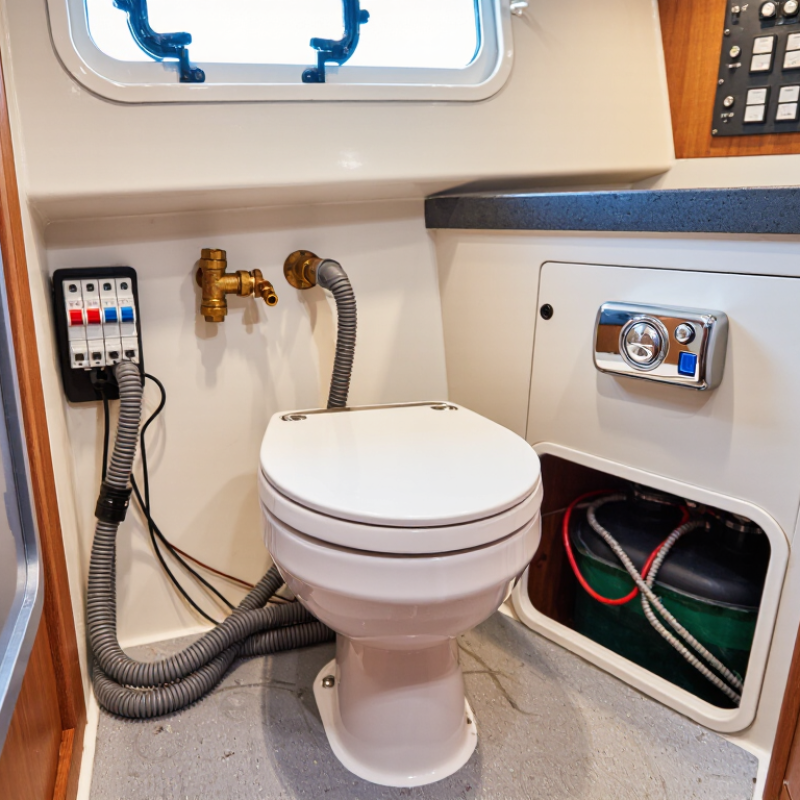
Table of Contents [Hide]
Define Your Boat’s Marine Toilet Requirements
How to Choose a 12 Volt Marine Toilet for Your Boat?
Define Your Boat’s Marine Toilet Requirements
Choosing a 12-volt marine toilet starts with use, not appearance. Define the crew size, trip length, and installation space first. A weekend couple needs less capacity than a six-person cruising crew. NMMA’s 2023 U.S. Recreational Boating Statistical Abstract counted about 11.6 million registered recreational boats. That scale reflects widely different layouts, users, and operating habits.
Count daily flushes honestly. Then allow extra capacity for guests and delays. A practical calculation includes freshwater use, holding-tank volume, pump-out access, and hose length. Check whether the toilet serves a compact cabin, a fishing boat, or a liveaboard vessel. Each situation changes the required flushing performance. Measure the bowl footprint and service-clearance area before ordering. Small spaces punish optimistic measurements.
Electrical planning deserves equal attention. Confirm the battery’s usable capacity, cable length, fuse rating, and voltage drop. A 12-volt pump may work poorly when wiring is undersized. That mistake is common. Use marine-grade wiring and follow applicable ABYC guidance. ISO 8099 also provides useful design references for small-craft waste systems. Consider noise, odor control, winter storage, and manual backup needs. A quiet toilet can still disappoint if its holding tank fills quickly. I would also question marketing claims that ignore real water consumption. Test the complete system under normal battery voltage, not only at the dock.